

Ponavljanje: Everything from lessons 1 to 10 reviewed
Everything from the first ten lessons and the three topic lessons on one cheat sheet. Not sure about something? Click the small link to the lesson. After that, 20 exercises are waiting where everything comes together.
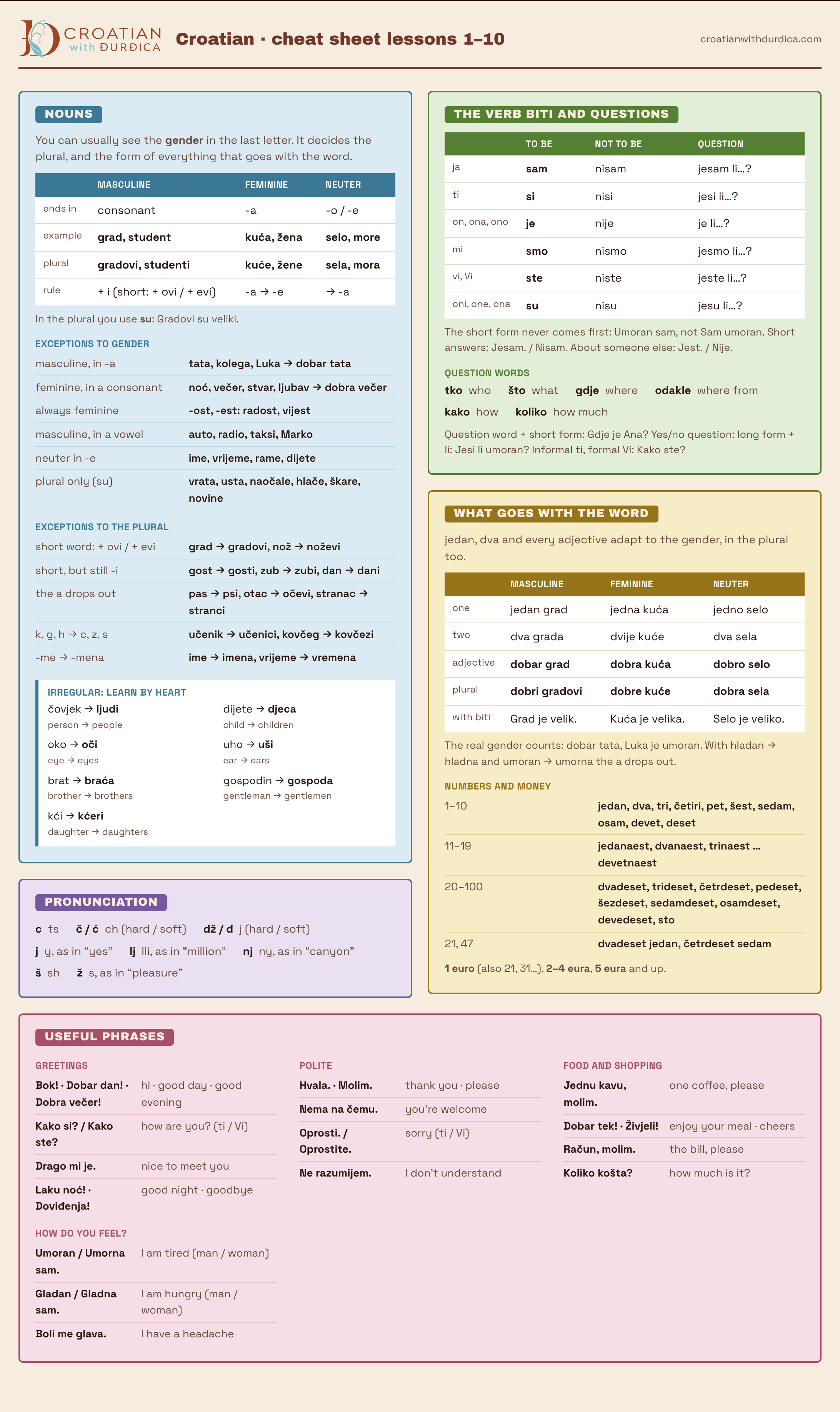
Print the cheat sheet or keep it on your phone, handy to have next to you while practicing.
 Croatian · cheat sheet lessons 1–10croatianwithdurdica.com
You can usually see the gender in the last letter. It decides the plural, and the form of everything that goes with the word.
| masculine | feminine | neuter | |
|---|---|---|---|
| ends in | consonant | -a | -o / -e |
| example | grad, student | kuća, žena | selo, more |
| plural | gradovi, studenti | kuće, žene | sela, mora |
| rule | + i (short: + ovi / + evi) | -a → -e | → -a |
In the plural you use su: Gradovi su veliki.
Exceptions to gender
- masculine, in -a
- tata, kolega, Luka → dobar tata
- feminine, in a consonant
- noć, večer, stvar, ljubav → dobra večer
- always feminine
- -ost, -est: radost, vijest
- masculine, in a vowel
- auto, radio, taksi, Marko
- neuter in -e
- ime, vrijeme, rame, dijete
- plural only (su)
- vrata, usta, naočale, hlače, škare, novine
Exceptions to the plural
- short word: + ovi / + evi
- grad → gradovi, nož → noževi
- short, but still -i
- gost → gosti, zub → zubi, dan → dani
- the a drops out
- pas → psi, otac → očevi, stranac → stranci
- k, g, h → c, z, s
- učenik → učenici, kovčeg → kovčezi
- -me → -mena
- ime → imena, vrijeme → vremena
Irregular: learn by heart
- čovjek → ljudiperson → people
- dijete → djecachild → children
- oko → očieye → eyes
- uho → ušiear → ears
- brat → braćabrother → brothers
- gospodin → gospodagentleman → gentlemen
- kći → kćeridaughter → daughters
Pronunciation
Lesson 1- c ts
- č / ć ch (hard / soft)
- dž / đ j (hard / soft)
- j y, as in “yes”
- lj lli, as in “million”
- nj ny, as in “canyon”
- š sh
- ž s, as in “pleasure”
| to be | not to be | question | |
|---|---|---|---|
| ja | sam | nisam | jesam li…? |
| ti | si | nisi | jesi li…? |
| on, ona, ono | je | nije | je li…? |
| mi | smo | nismo | jesmo li…? |
| vi, Vi | ste | niste | jeste li…? |
| oni, one, ona | su | nisu | jesu li…? |
The short form never comes first: Umoran sam, not Sam umoran. Short answers: Jesam. / Nisam. About someone else: Jest. / Nije.
Question words
- tko who
- što what
- gdje where
- odakle where from
- kako how
- koliko how much
Question word + short form: Gdje je Ana? Yes/no question: long form + li: Jesi li umoran? Informal ti, formal Vi: Kako ste?
jedan, dva and every adjective adapt to the gender, in the plural too.
| masculine | feminine | neuter | |
|---|---|---|---|
| one | jedan grad | jedna kuća | jedno selo |
| two | dva grada | dvije kuće | dva sela |
| adjective | dobar grad | dobra kuća | dobro selo |
| plural | dobri gradovi | dobre kuće | dobra sela |
| with biti | Grad je velik. | Kuća je velika. | Selo je veliko. |
The real gender counts: dobar tata, Luka je umoran. With hladan → hladna and umoran → umorna the a drops out.
Numbers and money
- 1–10
- jedan, dva, tri, četiri, pet, šest, sedam, osam, devet, deset
- 11–19
- jedanaest, dvanaest, trinaest … devetnaest
- 20–100
- dvadeset, trideset, četrdeset, pedeset, šezdeset, sedamdeset, osamdeset, devedeset, sto
- 21, 47
- dvadeset jedan, četrdeset sedam
1 euro (also 21, 31…), 2–4 eura, 5 eura and up.
Greetings
- Bok! · Dobar dan! · Dobra večer!
- hi · good day · good evening
- Kako si? / Kako ste?
- how are you? (ti / Vi)
- Drago mi je.
- nice to meet you
- Laku noć! · Doviđenja!
- good night · goodbye
Polite
- Hvala. · Molim.
- thank you · please
- Nema na čemu.
- you’re welcome
- Oprosti. / Oprostite.
- sorry (ti / Vi)
- Ne razumijem.
- I don’t understand
Food and shopping
- Jednu kavu, molim.
- one coffee, please
- Dobar tek! · Živjeli!
- enjoy your meal · cheers
- Račun, molim.
- the bill, please
- Koliko košta?
- how much is it?
How do you feel?
- Umoran / Umorna sam.
- I am tired (man / woman)
- Gladan / Gladna sam.
- I am hungry (man / woman)
- Boli me glava.
- I have a headache
Finished this lesson? Tick it off and it will show up in your progress (you need an account for that).